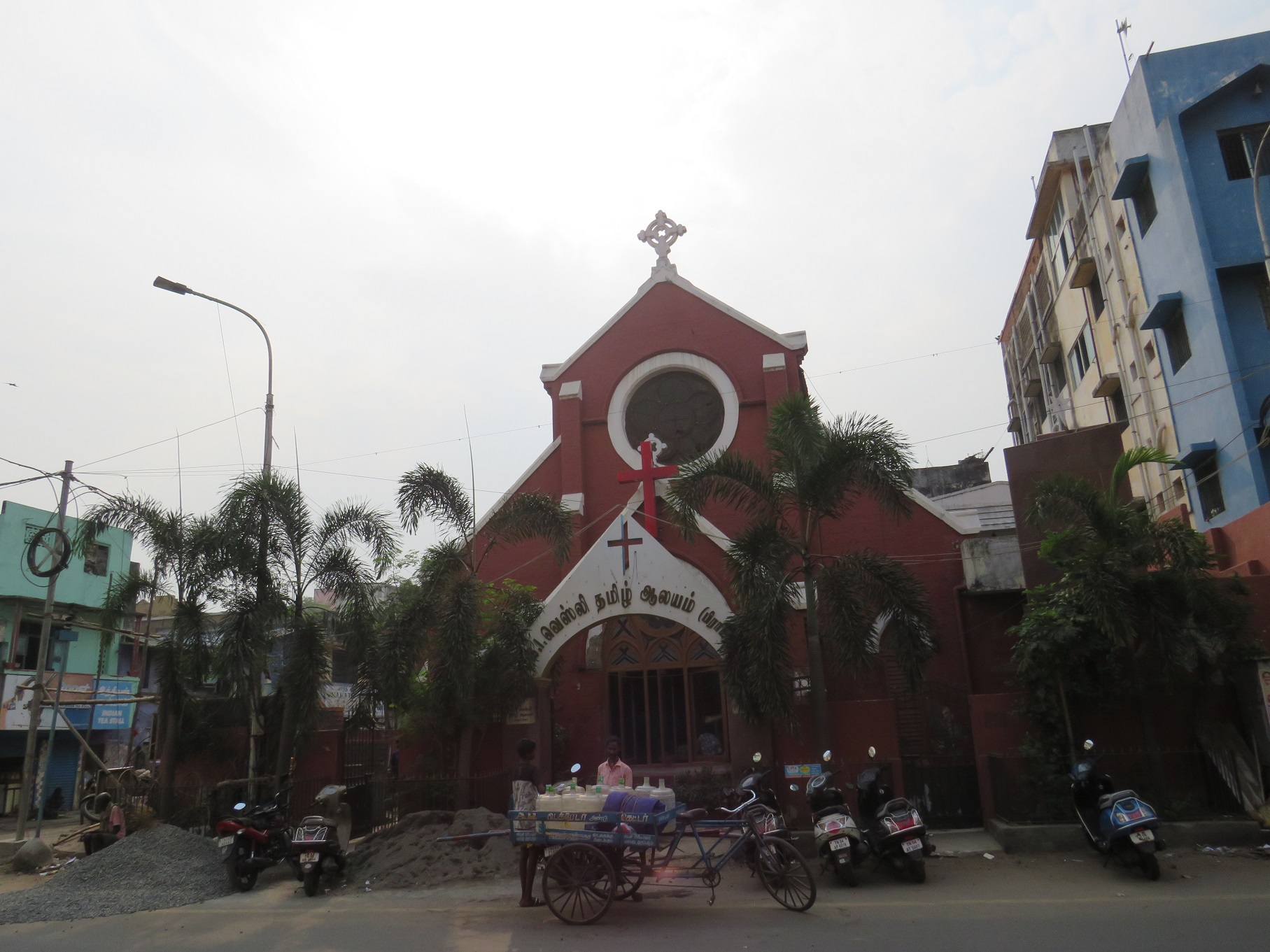
CSI Tamil Wesleyan Church, Broadway – A 19th-Century Church in Old Madras
Broadway is anything but broad today.
Shops spill towards the road, buses and vehicles compete for space, and even walking through this part of George Town can test one’s patience. Yet beneath the noise and congestion lies one of the oldest commercial neighbourhoods of Madras.
The road itself was created during the 1780s. An old drainage channel known as Atta Pallam was filled, and a new thoroughfare was laid across the reclaimed land. It came to be called Popham’s Broadway, after Stephen Popham, who played an important role in its development.
By the nineteenth century, Broadway had become a major commercial street. Traders, printing establishments, hospitals, theatres, schools and places of worship appeared along and around it.
Among the surviving reminders of that period is the CSI Tamil Wesleyan Church.
The Wesleyan Mission in Madras
The Wesleyan Mission began its work in Madras in 1817.
The Wesleyans belonged to the Methodist tradition that grew from the religious movement associated with John Wesley in eighteenth-century England. Missionaries from Britain travelled to different parts of the world, establishing congregations, schools and places of worship.
In Madras, their work gradually developed among both English-speaking residents and the local Tamil population.
The church now known as the CSI English Wesley Church was built on Broadway and opened on 25 April 1822. As the Tamil-speaking congregation expanded, the need arose for a separate place of worship where services could be conducted in Tamil.
That led to the construction of the Tamil Wesleyan Church.
A Separate Church for the Tamil Congregation
The building now known as the CSI Tamil Wesleyan Church was inaugurated in 1861.
This was more than the opening of another church on the same street. It reflected the growth of a Tamil Christian congregation within the Wesleyan mission in Madras.
The English and Tamil churches stood close to one another, but they served congregations with different languages and social backgrounds. Their presence on the same road reveals how missionary activity in nineteenth-century Madras gradually moved beyond the European community and became rooted among local residents.
The term CSI was added much later. The Church of South India was formed in 1947 through the union of several Protestant traditions, including Methodist churches. The two Wesleyan churches subsequently became part of the CSI.
A Church Easy to Miss
Broadway has changed beyond recognition since the church was inaugurated.
The road that once served as a prominent commercial avenue of Madras is today crowded with shops, signboards, buses and constant movement. Heritage buildings that once defined the street have either disappeared or become difficult to notice behind later additions.
The Tamil Wesleyan Church survives within this altered streetscape.
It is not a vast cathedral standing inside an open campus. Nor does it dominate Broadway through scale. Its importance becomes clearer only when one pauses and remembers that Christian worship has continued at this site since the nineteenth century.
That continuity is what gives the church its value.
A traveller moving hurriedly through Broadway may pass it without a second glance. Someone exploring Old Madras, however, will see it as part of a much larger story — the story of missionaries, Tamil congregations and the religious diversity that developed within the commercial heart of the city.
Two Wesleyan Churches on Broadway
The proximity of the Tamil and English Wesleyan churches makes this part of Broadway particularly interesting.
The CSI English Wesley Church, dating to 1822, is the older of the two. The CSI Tamil Wesleyan Church, inaugurated in 1861, represents the next phase in the growth of the mission.
Together, they preserve nearly two centuries of Wesleyan history in Chennai.
The churches can also be viewed alongside other historic Christian landmarks in the neighbourhood. Broadway and the surrounding streets have the Tucker Church, Arcot Lutheran Church, St. Francis Xavier’s Church and several other institutions connected with different missionary organisations and Christian traditions.
This concentration of churches is easy to overlook because Broadway is now identified mainly with trade and traffic.
Why This Church Matters
The CSI Tamil Wesleyan Church may not be among Chennai’s most famous churches. It does not usually appear on conventional tourist itineraries.
But heritage is not determined only by size, architectural grandeur or popularity.
The church represents the establishment of a Tamil-speaking Wesleyan congregation in nineteenth-century Madras. It also recalls a period when Broadway was one of the city’s most important streets and religious institutions stood alongside commercial establishments, schools, theatres and printing presses.
The building has survived while much of the Broadway of that period has vanished.
That alone gives us a reason to stop and look.
Those interested in the heritage of Old Madras can combine this visit with the nearby CSI English Wesley Church and follow my Broadway Heritage Walk to discover the other surviving landmarks of this remarkable street.
Happy travelling.


Comments
Post a Comment