Thirukkachur Temples
Thirukkachur is a small village located about 3 km from Singaperumal Koil, near Chengalpattu. Though the village is modest in size, it occupies an important place in the sacred geography of Tamil Nadu. It is counted among the Paadal Petra Sthalams, the Shiva temples praised in the Tevaram hymns. Interestingly, Thirukkachur is home not to one, but to three ancient Shiva temples, each associated with a distinct legend.
Temple No. 1: Oushadheeswarar Temple
Thirukkachur has a small hillock known as Oushadhagiri. At the foot of this hill stands the ancient Oushadheeswarar Temple, dedicated to Shiva. The presiding deity is worshipped as Oushadheeswarar or Marundeeswarar, both names reflecting the temple’s association with medicinal herbs and healing.
The temple entrance faces south and does not have a rajagopuram. The main sanctum faces west and enshrines Oushadheeswarar in the form of a Shiva linga. In front of the sanctum are Nandi, the dwaja sthambam, and the bali peetham.
The goddess is worshipped as Andakara Nivarani or Irul Neekki Amman, both names meaning the one who removes darkness. She is enshrined in a separate south-facing shrine.
The temple has a spacious prakara containing small shrines and icons of Ganesha, Bhairava, Chandikeshwarar, and the Navagrahas. The koshta niches on the outer wall of the main sanctum contain reliefs of Ganesha, Dakshinamurti, Vishnu, Brahma, and Durga.
Near the main entrance is a pillared mandapa with beautiful carvings. Another important feature is the Oushadha Teertham, a deep stepwell reached by descending more than sixty steps. Both the hill and the water of this well are traditionally believed to possess medicinal properties.
According to the temple legend, Indra directed the Ashwini Devas to come here, worship Shiva, and search for rare medicinal herbs. It is also believed that Agastya worshipped Shiva at both Thiruvanmiyur and Thirukkachur, thereby deepening his knowledge of herbal medicine.
The sthala vruksha is the palaa maram, or jackfruit tree. The circumambulation of the hill, known as giri valam, is particularly popular here. On full moon days, many devotees walk around the hillock as an act of worship.
Sundaramurti Nayanar, popularly known as Sundarar, composed two Tevaram hymns in praise of Oushadheeswarar. The temple is believed to have received patronage from the Chola king Kulothunga Chola.
Temple No. 2: Irandhiteeswarar Temple
The second temple is connected with a touching episode from the life of Sundarar.
According to the legend, Sundarar arrived at Thirukkachur to worship Shiva. He was extremely hungry but had no food. Shiva then appeared in the form of an elderly Brahmin and went from house to house seeking alms. He collected food from the villagers and served it to Sundarar.
Because Shiva begged for food to feed his devotee, he came to be known as Irandhiteeswarar, meaning the one who sought alms. He is also called Virundhiteeswarar, the one who offered a feast.
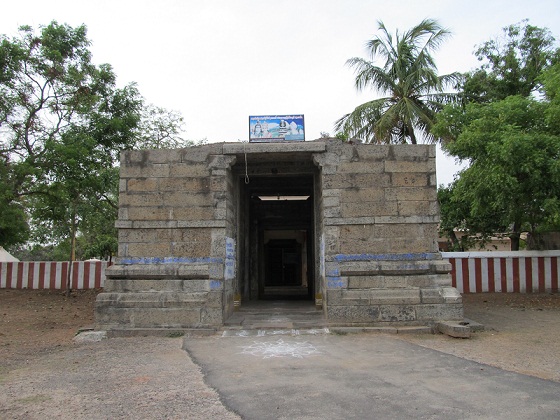
The small Irandhiteeswarar Temple stands in the middle of the village, on the route between the Oushadheeswarar hill temple and the Katchabeswarar Temple. It is extremely difficult to locate, and even some local residents may not immediately recognise it. A small shop locally referred to as the Bhai Kadai serves as the nearest landmark.
The shrine is very simple and contains only one sacred form, Irandhiteeswarar as a Shiva linga. Even Nandi, normally found facing the sanctum in Shiva temples, is absent here. The stark simplicity of this shrine reflects the humble character of the legend associated with it.
Temple No. 3: Katchabeswarar or Thyagaraja Temple
The third and largest temple in Thirukkachur is the Katchabeswarar Temple, also known as the Thyagaraja Temple. Though the complex is extensive, it does not have a rajagopuram. A separate mandapa stands on the roadside, facing the temple.
The name Katchabeswarar is connected with the legend of Vishnu’s Kurma avatar. During the churning of the cosmic ocean, Vishnu assumed the form of a tortoise to support the mountain and prevent it from sinking. Before undertaking this task, he is believed to have worshipped Shiva at Thirukkachur and sought the strength required to fulfil his duty.
The Tamil word kachchapa refers to a tortoise. Because Vishnu in tortoise form worshipped Shiva here, the deity came to be known as Katchabeswarar, and the village acquired the name Thirukkachur.
Katchabeswarar is enshrined as a small Shiva linga. Though the sanctum itself is oriented towards the east, there is no entrance on that side. The actual entrance to the shrine is from the south. In front of the sanctum is an ornamental stone window, along with a small Nandi. The bronze utsava murtis are also kept within the main shrine.
In the maha mandapa outside the main sanctum is a separate south-facing shrine for the goddess Anchanatchi.
The inner prakara around the main shrine contains icons of Surya and the Nalvar. The koshta niches on the outer wall carry reliefs of Ganesha, Dakshinamurti, Vishnu, Brahma, and Durga. A separate shrine for Chandikeshwarar is also present in the usual location.
The same prakara contains several other icons and shrines, including:
Gnana Ganapathy
Choleeswara Linga
Kalateeswarar
Maheswari
Margasagaya Ishwara Linga
Naga Linga
Nagaraja
Ramalinga
Viswanathar
Murugan with Valli and Devasena
Nataraja with Sivakami, represented as bronze utsava murtis
Icons of Ganesha and Murugan are also found at the entrance to the main shrine.
Outside the shrines of Katchabeswarar and Anchanatchi is a separate shrine for Thyagaraja. It houses the bronze Somaskanda group of Shiva, Parvati, and Murugan. It is because of this shrine that the temple is also known as the Thyagaraja Temple.
In front of the Thyagaraja shrine is a mandapa with pillars covered in miniature sculptures. This structure is known as the Nakshatra Mandapa.
The temple has a large open prakara without a roof. Facing the main shrine are the dwaja sthambam, a large Nandi, and the bali peetham. Small icons of Ganesha and Murugan are also placed near the entrance.
The outer prakara additionally contains a large shrine for Maha Ganapathy, another for Subramanya with Valli and Devasena, and smaller shrines for Bhairava and Sundarar.
Sundarar has also sung Tevaram hymns in praise of Katchabeswarar.
Thirukkachur is therefore not just one sacred site, but a cluster of three closely connected Shiva temples. Oushadheeswarar is linked with healing and medicinal knowledge, Irandhiteeswarar with Shiva feeding his hungry devotee, and Katchabeswarar with Vishnu worshipping Shiva before assuming the tortoise form. Together, they make this quiet village near Chengalpattu a remarkably rich pilgrimage destination.
Happy travelling.
 |
| Oushadheeswarar Temple |
 |
| Oushadh Teerth |
 |
| Irandhiteeswarar Temple |
 |
| Vishnu in the form of tortoise worshipping Shiva |
 |
| Mandap outside the temple of Thyagarajar |


Comments
Post a Comment